

A Complete Guide for Gardens That Last
UAE summers are not gentle on outdoor plants. High temperatures, sandy soil, dry winds, irrigation gaps, and salinity can quickly expose whether a garden has been planted with the right species or not.
That is why choosing plants for a UAE garden should never be based on appearance alone. The best plants for UAE summer heat are the ones that can handle local conditions, establish strong roots, and continue performing through the hottest months with the right care.
At Wahat Al Sahraa Nurseries in Al Khawaneej, Dubai, our team works with homeowners, landscapers, contractors, consultants, and developers looking for trees and plants suited to real UAE landscapes. From native trees and palms to flowering shrubs, succulents, groundcovers, and mature specimens, the right selection can make the difference between a garden that struggles and a landscape that settles, grows, and adds long term value.
Q: Which plants grow best in Dubai's hottest climate?
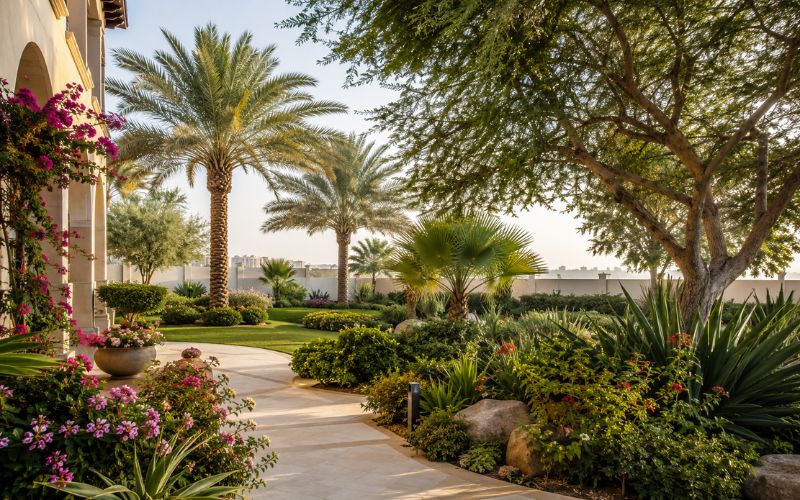
The plants that grow best in Dubai’s hottest climate are heat-adapted natives and succulents: the Ghaf (Prosopis cineraria), Sidr (Ziziphus spina-christi), Acacia, Neem, Date Palm, Bougainvillea, and succulents like Agave and Aloe Vera. These species withstand 45–50°C consistently and need minimal water once established. The Ghaf — the UAE’s national tree — is the gold standard: it fixes nitrogen in sandy soil, tolerates high salinity, and lives for decades. At Wahat Al Sahraa, we stock all of these in our 4,000+ plant varieties, including large mature specimens ready for immediate landscape impact.
Q: What are the best heat-tolerant trees for the UAE?
The most reliable heat-tolerant trees for the UAE are the Ghaf, Sidr, Acacia (Acacia tortilis and Acacia arabica), Neem (Azadirachta indica), Date Palm, and Tecoma. All withstand extreme heat with little water once established. Ghaf and Sidr are native heritage trees built for desert conditions, while Neem and Ficus offer fast, dense shade. These are the trees UAE landscapers and villa owners rely on for gardens that last.
Q:Which flowering plants survive Dubai summer heat?
The flowering plants that survive Dubai summer heat are Bougainvillea, Desert Rose (Adenium), Oleander, Lantana, Tecoma (yellow bells), and Plumeria (frangipani). Bougainvillea is the UAE favourite — vibrant, extremely drought-tolerant, and happy to bloom in poor soil with little water. Desert Rose and Lantana add colour while needing almost no upkeep, making them ideal for low-maintenance villa gardens.
Q: What are the best low-water plants for a UAE garden?
Most indoor plants enjoy an occasional misting of water. This is especially beneficial to plants placed in centrally air-conditioned rooms, as the air becomes very dry. Misting acts as a good moisturizer and can be done using a spray bottle. Make sure you use room temperature water to spray.
Q: What are the best low-water plants for a UAE garden?
The most water-efficient choices are succulents and natives: Agave, Aloe Vera, Golden Barrel Cactus, and the native Ghaf, Sidr, and Acacia trees. Agave and Aloe store water in their thick leaves and require almost no irrigation. Native trees, once established (usually after the first year), survive on deep watering just a few times a month. Grouping plants with similar water needs together also lets a drip-irrigation system run far more efficiently.
Q: What are the best shade trees for a Dubai villa?
The best shade trees for a Dubai villa are Ficus Nitida (Indian Laurel Fig), Neem, and the Rain Tree (Samanea saman). Ficus Nitida is one of the most popular shade trees for villa gardens and commercial landscapes. Neem offers a wide, semi-evergreen canopy and is extremely salt-tolerant, making it ideal for coastal villas. For an open garden or a majlis seating area, the Ghaf provides light, dappled shade that cools without blocking all sunlight.
Q: When is the best time to plant trees in the UAE?
The best time to plant trees in the UAE is October to March, when temperatures are cooler. This gives roots time to establish before the summer heat arrives. That said, mature, container-grown, and balled-and-burlapped trees from an established nursery can be planted year-round with the right aftercare — which is why many landscapers schedule large-tree installations using our crane delivery service even outside the cooler months.
Q: How do you keep a garden alive in UAE summer?
To keep a garden alive in UAE summer, four practices make the biggest difference: water early morning or late evening to reduce evaporation; use drip irrigation rather than spray; mulch or apply gravel to retain soil moisture and protect roots from heat; and improve sandy soil with compost so it holds water. A deep soak a few times a week beats shallow daily watering for building heat resistance.
Q: Can you plant trees during UAE summer?
Yes, you can plant trees during UAE summer if they are mature, container-grown specimens handled correctly. Mature trees also give your landscape an instant established look instead of waiting years for growth. At Wahat Al Sahraa, we supply large specimen trees and offer crane delivery and professional installation across the UAE, so even fully grown Ghaf, palms, and shade trees can be safely transported and planted — valuable for contractors and villa owners who need immediate impact for a project handover or finished garden.
Q: Where can I buy heat-tolerant plants and trees in the UAE?
Wahat Al Sahraa Nurseries, located on Al Amardi Street in Al Khawaneej, Dubai, is among the largest plant nurseries in the UAE and the Middle East, with over 10 million square feet of nursery land and more than 4,000 plant varieties. We serve homeowners, landscapers, and contractors across the Emirates with native and adaptive plants, mature trees, UAE-wide delivery, crane installation, and contract growing for large projects. Visit us in Al Khawaneej, browse our plant catalogue, or send an enquiry and our team will respond within 24 hours.