

Native & Adaptive Plants for UAE Gardens: A Practical Guide
If you’ve ever planted something beautiful in your garden only to watch it struggle through a Dubai summer, you’re not alone. The UAE’s climate is unforgiving — intense heat, high salinity, low rainfall, and long stretches of direct sun. Not every plant is built for it, no matter how well you water it.
That’s where native and adaptive plants come in. They’re not a trend — they’re a practical response to the environment most of us are actually gardening in.
This guide covers what these plants are, why they perform differently from imported ornamentals, who benefits most from using them, and how to start incorporating them into a garden or landscape project.
What's the Difference Between "Native" and "Adaptive" Plants?
The two terms get used interchangeably, but they mean different things.
Native plants are species that occur naturally in the UAE and the wider Arabian Peninsula. They’ve evolved over thousands of years to handle this exact climate — the heat, the soil salinity, the irregular rainfall. The Ghaf tree (Prosopis cineraria), the UAE’s national tree, is the best-known example. Its deep root system allows it to access groundwater far below the surface, which is part of why it can survive conditions that would kill most other trees.
Adaptive plants aren’t originally from this region, but come from climates that share similar challenges — hot, dry, or coastal environments in places like the Mediterranean, parts of Australia, or Sub-Saharan Africa. Over years of cultivation in the UAE, these species have proven they can handle local conditions, even though they didn’t evolve here.
In practice, most well-designed UAE gardens use a mix of both — native species for structure and resilience, adaptive species for variety in texture, colour, and form.
Why Native and Adaptive Plants Make Sense Here
Lower Water Requirements
Once established, many native and adaptive species need significantly less irrigation than imported ornamentals. This matters in a region where water is a genuine cost consideration, both for a single villa garden and for large-scale landscape projects with ongoing irrigation budgets.
Built for the Heat — Not Just Surviving It
There’s a difference between a plant that tolerates UAE summer temperatures and one that’s actually suited to them. Native and adaptive species fall into the second category. They’re not fighting the climate to stay alive; their root systems, leaf structures, and growth patterns are built around it.
Lower Long-Term Maintenance
A garden built around the wrong species spends a lot of its life being rescued — replaced after a harsh summer, propped up with extra feeding, fighting stress symptoms. Native and adaptive planting reduces that cycle. Fewer losses. Less replacement. Less ongoing intervention to keep things looking presentable.
A Landscape That Actually Belongs Here
There’s also a simpler reason to consider this approach: a garden built around plants that are supposed to be in this environment tends to look more cohesive and age more gracefully than one constantly working against its surroundings.
How to Start Incorporating Native and Adaptive Plants
You don’t need to redesign an entire garden overnight. A few practical starting points:
- Start with structure. Trees and larger shrubs are the most visible, highest-impact place to begin — they set the tone for the rest of the space and are the most costly to replace if they fail.
- Think in layers. Combine native and adaptive species for the “bones” of the garden (trees, structural shrubs) with seasonal or ornamental planting for colour, rather than relying on imported ornamentals throughout.
- Match the right plant to the right spot. Even within native and adaptive species, sun exposure, soil type, and irrigation access still matter. A nursery team can help match species to your specific site conditions.
- Don’t assume “low water” means “no water.” Native and adaptive doesn’t mean zero maintenance — it means significantly reduced maintenance once a plant is established, which typically takes one to two growing seasons.
Frequently Asked Questions
Are native plants harder to find than common ornamental plants?
Not necessarily — but they’re often less visible in everyday landscaping because imported ornamentals have historically been the default choice. A nursery with a dedicated native and adaptive plant collection makes them just as accessible.
Do native and adaptive plants still need irrigation in the UAE?
Yes, especially during the establishment period. The difference is in the long-term water requirement once roots are developed — significantly lower than most imported ornamentals, not zero.
Can native and adaptive plants be used in formal or landscaped gardens, not just desert-style ones?
Yes. Many native and adaptive species can be pruned, shaped, and incorporated into structured garden designs — they’re not limited to a single aesthetic.
Is the Ghaf tree suitable for a home garden, or only large landscapes?
The Ghaf tree can be used in home gardens, though its mature size and deep root system are worth planning for in advance, particularly near structures or underground utilities.
Where to Find Them
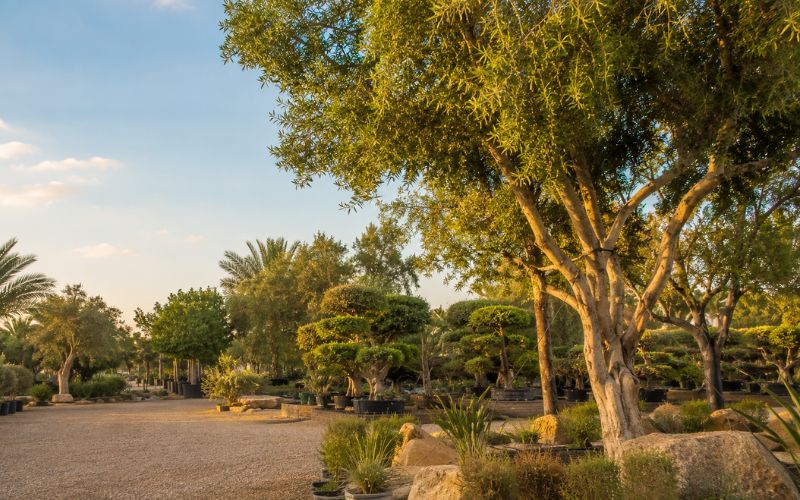
Wahat Al Sahraa stocks a dedicated Native Plants category as part of our wider inventory of over 4,000 plant varieties, alongside Mediterranean specialties and other adaptive species suited to UAE conditions.
Visit our nursery in Al Khawaneej, Dubai, or browse our plant catalogue to see what’s currently available.